February Site Updates - NMITE Centre for Innovation and Future Skills
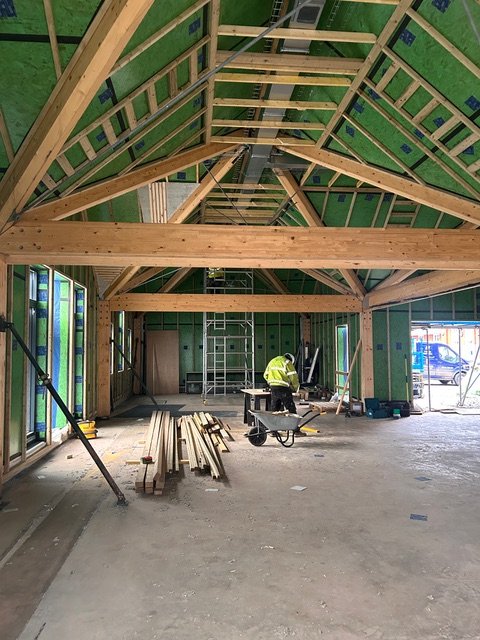
One of the real advantages of visiting site regularly is the opportunity to check progress firsthand and feed into the finer details that ultimately define the quality of the finished space. This week’s focus was the installation of the timber batten ceiling, which we reviewed on site with the carpenter to finalise both aesthetic and practical considerations.
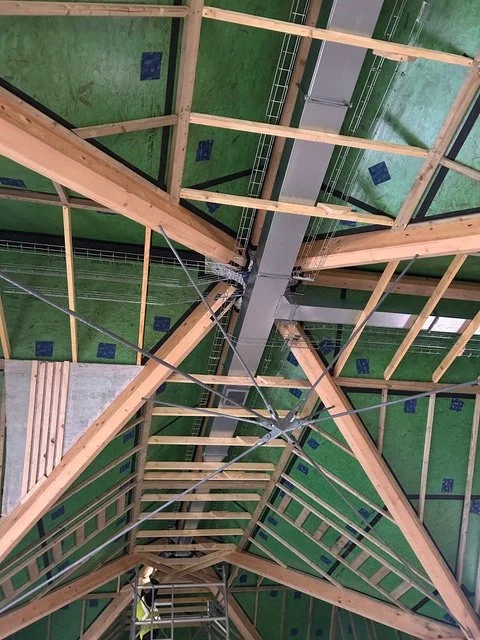
The ceiling build-up will include acoustic insulation between the cladding battens, finished with an acoustic fabric from Camira. Over this, 38 mm-wide softwood decorative battens will be fixed at 25 mm centres to create the final visual layer. Because the roof geometry creates multiple ceiling planes, careful thought is needed around how the battens align, intersect, and terminate against walls and glazed elements to maintain a crisp, intentional appearance.
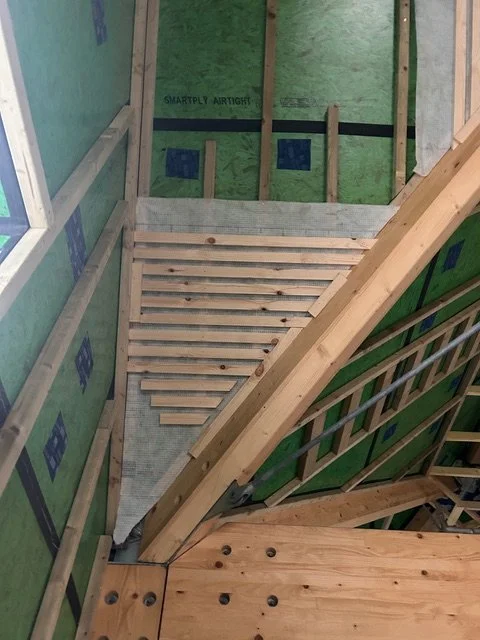
To explore the best approach, the on-site carpenter mocked up several edge detailing options using an airtightness membrane in place of the acoustic fabric. This allowed us to review the possibilities together and weigh up not only the visual outcome but also buildability factors such as installation time and potential material wastage.
We agreed on introducing a decorative perimeter framing batten. This detail allows the contractor to install the ceiling battens slightly overlength and then trim them in situ using the frame as a guide—removing the need for precise pre-measuring and reducing the risk of costly errors. The solution is efficient, practical, and visually effective, providing a clean border that emphasises the roof’s geometric form while giving each ceiling plane a defined edge.
It’s a great example of how collaborative problem-solving on site can improve both the construction process and the final design outcome.